Unexpected signal in the deep sky
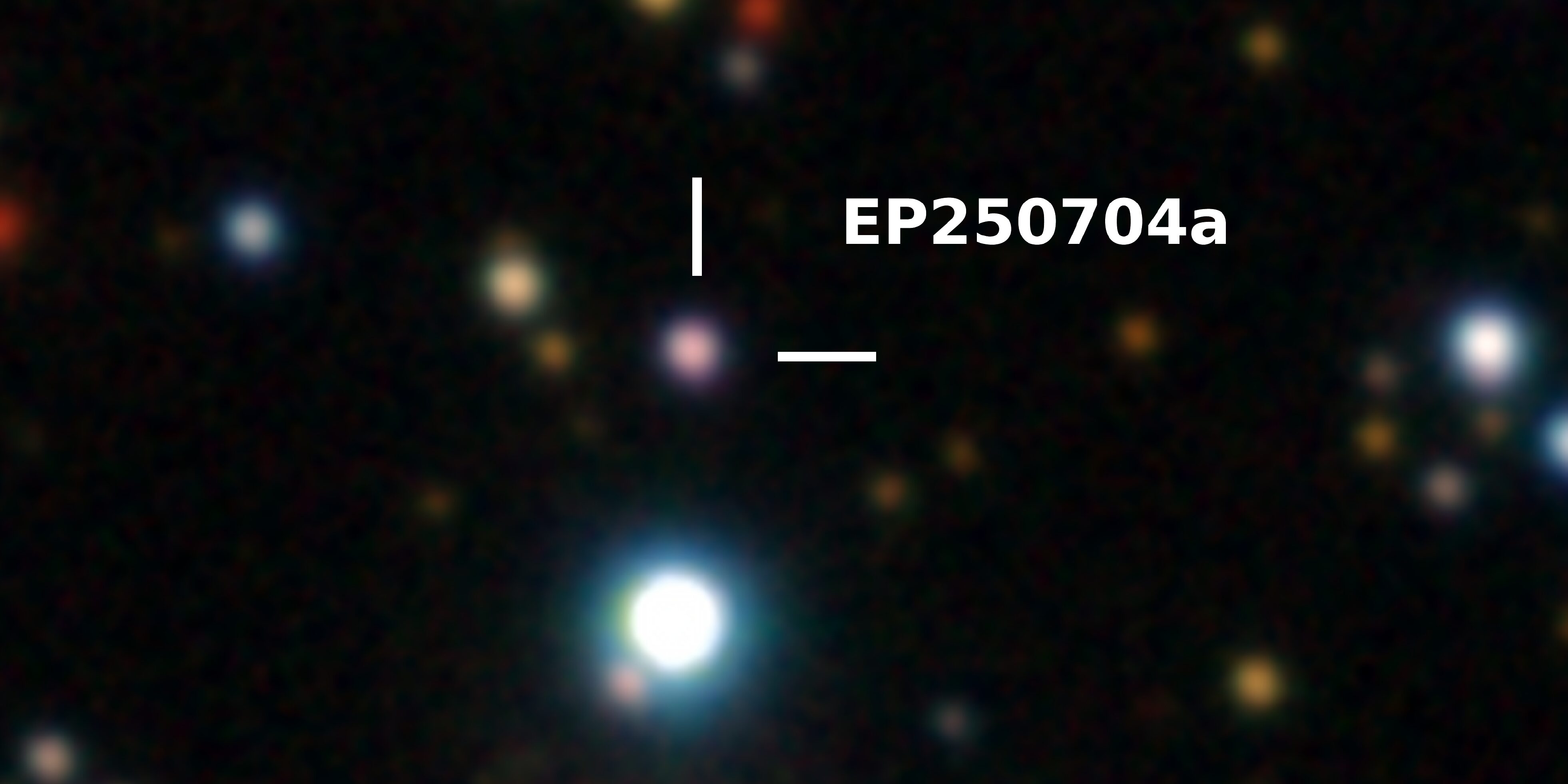
On July 4, 2025, satellites captured a gamma-ray flare that lasted only 0.4 seconds. Named GRB 250704B, the event soon revealed something even more intriguing: a continuous emission of soft X-rays that extended for 560 seconds.
The Einstein Probe satellite was responsible for recording this prolonged phase in the 0.5 to 4 keV range, more than a thousand times longer than the initial gamma-ray pulse.
What sets this event apart
Short gamma-ray bursts are usually linked to the merger of compact objects, such as two neutron stars or a neutron star and a black hole. What stands out in GRB 250704B is that the X-ray radiation does not fit the classic "afterglow" pattern produced by the ejected material colliding with the interstellar medium.
Researchers concluded that the prolonged emission must originate from the central remnant object of the collision itself.
Why the Einstein Probe was able to see it
Launched in early 2024, the Einstein Probe’s wide-field telescope monitors large portions of the sky simultaneously in soft X-rays. This allowed it to capture the signal right from the start, something conventional telescopes, which must be pointed after an alert, frequently miss.
Evidence of a magnetar
A plausible explanation is the temporary formation of a magnetar — a neutron star with extreme magnetic fields. This object could convert rotational and magnetic energy into radiation, sustaining the observed X-ray emission.
Observations with the Very Large Telescope (VLT) in Chile measured a redshift of z = 0.661, confirming that the event occurred billions of light-years away. No bright supernova was detected, reinforcing the hypothesis of a compact-object merger.
Implications for multi-messenger astronomy
If long X-ray emission proves common in similar mergers, satellites like the Einstein Probe could help identify electromagnetic counterparts of gravitational waves more quickly, opening a new detection channel for extreme cosmic events.