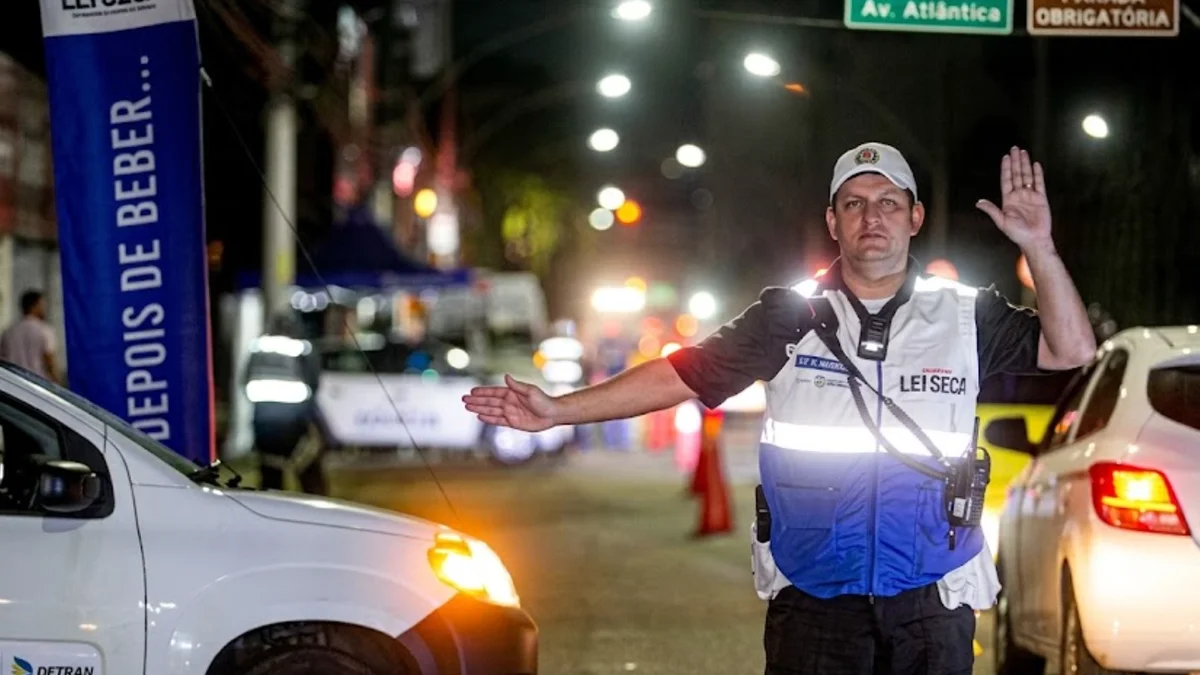
A new stage for the Dry Law
The National Traffic Council (Contran) formalized Resolution No. 1,031/2026, a document that now guides enforcement against drivers under the influence of alcohol and other psychoactive substances on highways and city streets across Brazil.
The publication reorganizes procedures that, until then, were scattered across previous rules and left room for differing interpretations among state and municipal traffic agencies.
What the resolution covers
The text's central focus is the regulation of enforcement — that is, how officers identify, approach, and cite drivers suspected of driving under the influence of alcohol or drugs.
Among the points addressed by the rule are:
- Standardization of approach procedures at checkpoints and routine operations;
- The authorities' work on federal and state highways and urban roads;
- Criteria for confirming the infraction when a breathalyzer test is refused;
- The signage required during enforcement operations.
Alcohol and other substances on the same radar
One of the resolution's highlighted axes is equalizing the treatment given to alcohol consumption and the use of psychoactive substances — a category that includes drugs and medications capable of impairing reflexes, attention, and reaction time behind the wheel.
In practice, the rule reinforces that driving ability can be impaired by different agents, not only by drinking alcohol.
What still applies to drivers
The resolution is a regulatory rule: it details enforcement operations, but it does not replace what is already established in the Brazilian Traffic Code (CTB).
Therefore, the following remain in force:
- Zero tolerance for alcohol in the body of anyone driving;
- The administrative sanctions set out in the CTB for those caught driving under the influence of alcohol or psychoactive substances, including fines and suspension of the right to drive;
- The possibility of criminal liability in cases that fall under current criminal legislation.
Practical effect on operations
The expectation is that standardization will bring greater legal predictability to citations. When procedures are uniform, there is less room for administrative challenges based on procedural flaws — something that historically overloads traffic agencies and courts.
For drivers, the takeaway is direct: operations tend to become more consistent, and the rigor of verification remains. The classic recommendation is still the safest — if you drink, don't drive, and use alternative transportation, ride-hailing apps, or a designated driver.
Next steps
With publication, state and municipal traffic executive agencies must adjust their internal protocols and train enforcement teams according to the new guidelines. Adoption should occur gradually, accompanied by updates to citation systems.
The Dry Law, enacted in Brazil in 2008 and tightened in subsequent years, remains one of the country's most relevant road safety policies. Resolution No. 1,031/2026 is part of this continuous effort to reduce traffic deaths and injuries — one of the main public health challenges in Brazilian cities and highways.