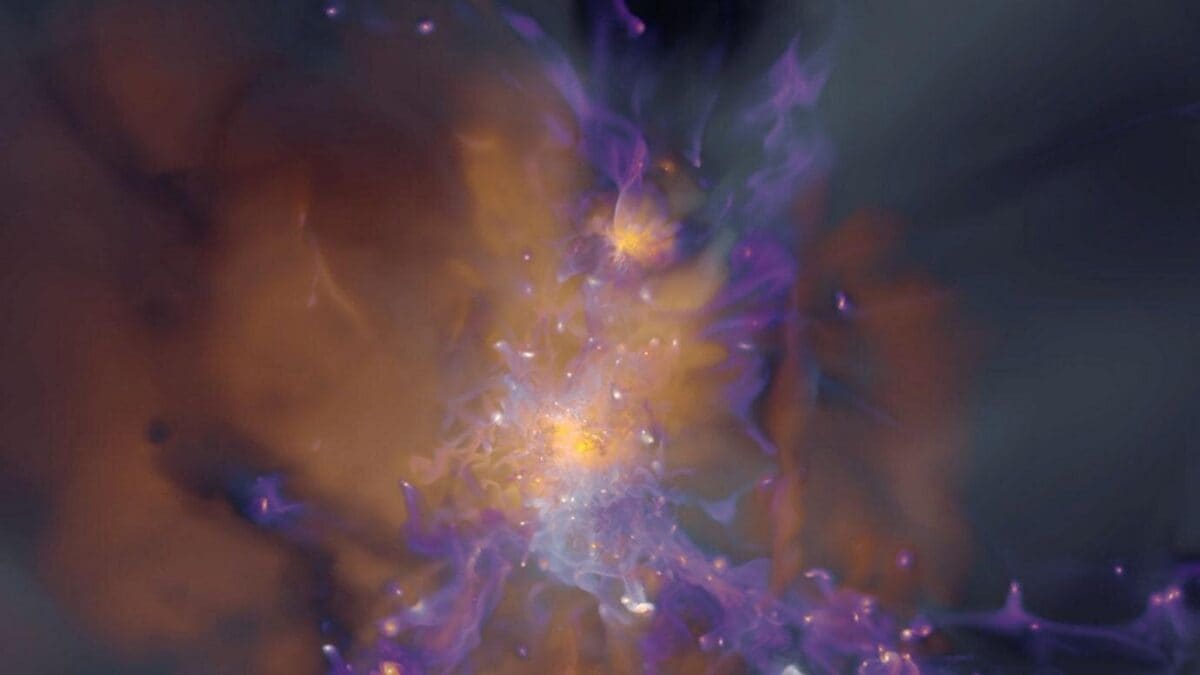
Unexpected Origin of Our Galaxy
The Milky Way we know today did not arise in isolation. According to a new simulation, it began as a cluster of thousands of small galaxies, some filled with stars in formation and others composed only of gas or remnants of dead stars and black holes.
Three Years of Intense Computing
Scientists from the University of Chicago, led by assistant professor Harley Katz, developed the MEGATRON project. The supercomputer worked continuously for three years to create the most detailed model ever made about the early evolution of the Milky Way.
The work incorporated all relevant physics, including gravity and radiation, and was fed with recent data from the James Webb Space Telescope.
Diversity of Ancestral Systems
The simulation shows that, in the first billions of years, there was a great variety of smaller galaxies:
- Some produced stars at an accelerated rate
- Others contained only gas
- Many harbored black holes or stars that had already exploded
These systems merged over time, forming the spiral disk we observe today.
Solution to an Ancient Enigma
The model also solved an astrophysical mystery: why the iron level in very faint dwarf galaxies remains constant, regardless of size. The explanation lies in the explosions of the so-called Population III stars, formed shortly after the Big Bang.
These stars released large amounts of iron, which escaped easily from smaller galaxies due to weak gravity.
Predictions for Future Observations
MEGATRON also predicts the existence of bright galaxies without visible stars, possibly formed only by gas or remnants of ancient explosions. Researchers believe that more advanced telescopes will be able to locate these structures and confirm the model's predictions.