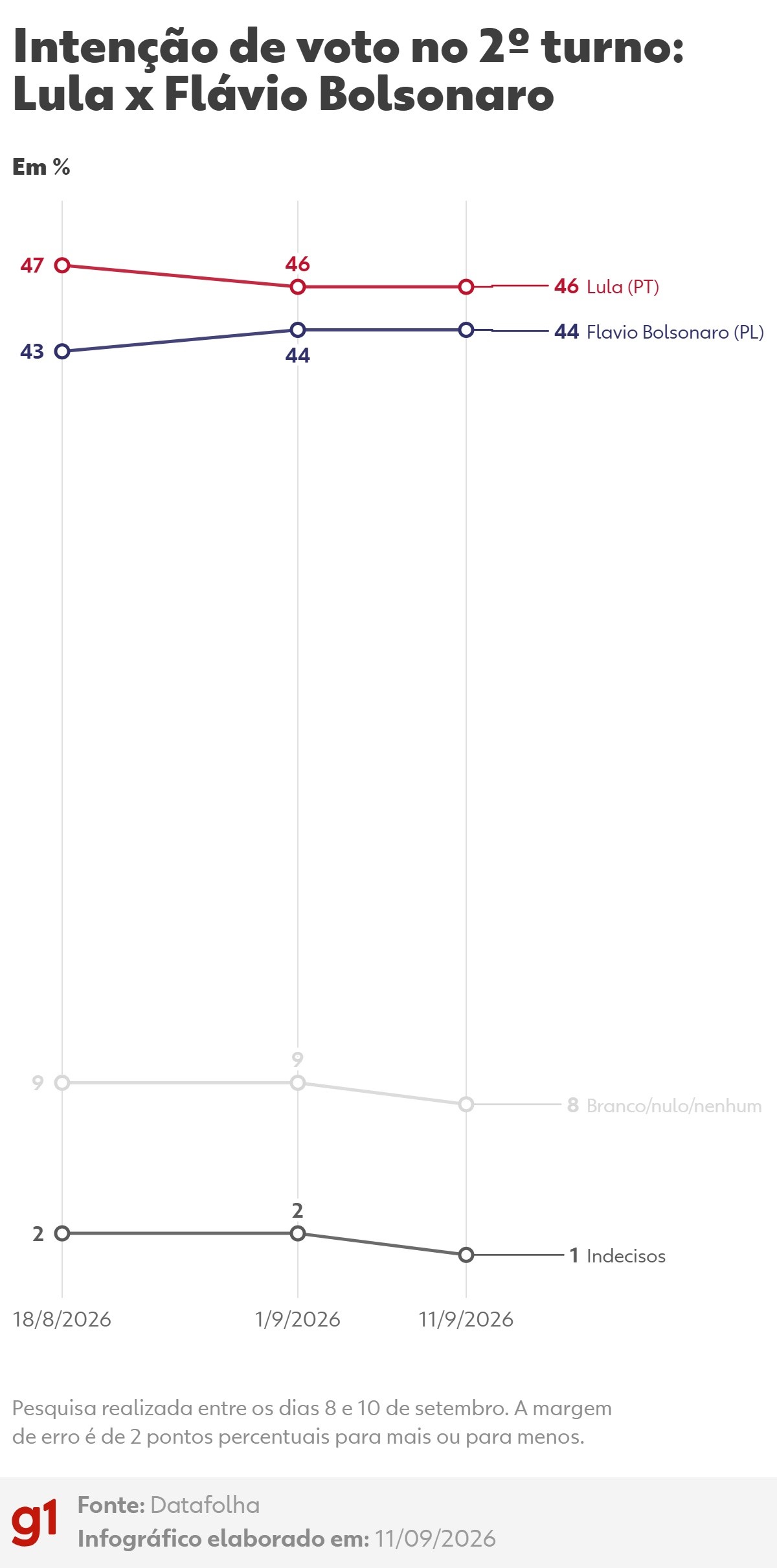
A tight race in the runoff scenario
A new Datafolha survey, released this Friday (11), projects a balanced scenario should the presidential election be decided in a runoff. In the simulation, President Lula (PT) draws 46% of voting intentions, while Senator Flávio Bolsonaro (PL) stands at 44%.
The two-percentage-point gap between the two names sits exactly at the limit of the study's margin of error, 2 points up or down. In practice, the result amounts to a technical tie, with no statistically consolidated advantage for either side.
What the number means
- 46% for Lula and 44% for Flávio Bolsonaro in a potential head-to-head matchup.
- The 2-percentage-point margin of error makes it impossible to claim a clear leader in the race.
- The scenario that emerges is one of high competitiveness, with the two pre-candidates practically neck and neck.
When the distance between competitors falls within the margin-of-error range, the convention is to treat the picture as a technical tie. That means small shifts in the next round of polls could change the order of the candidates without necessarily representing a real change in the electorate's trend.
Who commissioned the survey
The poll was commissioned by Globo and the newspaper Folha de S.Paulo, outlets that typically publish the institute's results jointly. The numbers released this Friday feed the debate about the shape of the presidential race and the strength of each political camp less than a year before the vote.
Reading the scenario
The balanced picture reinforces the reading that the election is likely to be decided vote by vote, with decisive weight from undecided voters and those who may still shift between the two poles. Runoff polls serve as a thermometer, but they do not anticipate the final result: the candidates' performance depends on factors such as the television campaign, public debate and the economic climate.
Analysts recommend watching the evolution of the institute's historical series, comparing the new survey with previous ones, rather than interpreting a single number in isolation. In races with a two-point margin of error, movements of one or two percentage points can occur without any structural change in the electorate's preference.