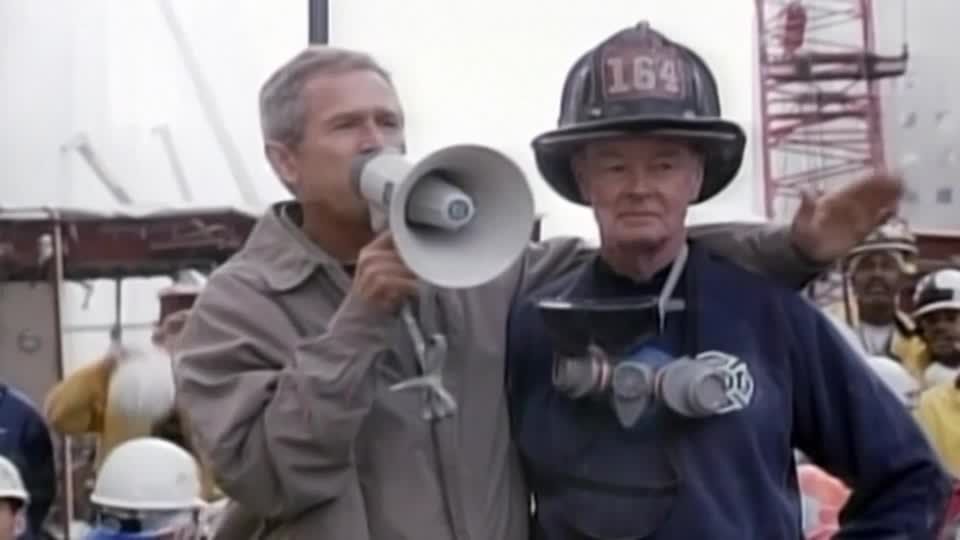
A quiet run before the chaos
On the morning of September 11, 2001, George W. Bush was on his usual run at a golf course in Florida. The then-president of the United States seemed relaxed. Among the few journalists accompanying him was Steve Holland, a Reuters correspondent. The trip had a simple agenda: an education event in Sarasota, at Emma E. Booker Elementary School.
The day began with clear skies and a protocol routine. No one in the entourage imagined that, hours later, the American president would be informed, in a classroom, that the country was under attack.
The first warning and initial confusion
While Bush was preparing to read with children, word arrived that a plane had hit one of the Twin Towers in New York. At first, aides treated the episode as a possible accident. The presidential entourage, however, began monitoring the situation with apprehension.
Steve Holland recalls that the press traveling with Bush received fragmented information. There was no clarity about the severity. Minutes later, a second plane hit the other tower. The accident hypothesis lost strength. It became evident that the United States was the target of a coordinated attack.
The whisper that stopped the country
It was inside the classroom that the decisive moment happened. Andrew Card, White House chief of staff, approached Bush and whispered in his ear. The phrase went down in history: A second plane hit the second tower. America is under attack.
The president did not get up immediately. He remained with the children for a few minutes, trying to stay calm and avoid panic. The expression on his face, however, changed. The Reuters reporter describes the scene as a moment of absolute tension, when routine was broken and the world seemed to stop.
Emergency decisions aboard
After leaving the room, Bush was taken to a private space. He called Vice President Dick Cheney and other aides. Then he made a brief address to the nation. The presidential entourage left Sarasota in haste.
Air Force One took off under heavy security. There was no certainty about how many other planes had been hijacked or about new targets. The route back to Washington was improvised. The presidential plane stopped at Barksdale Air Force Base in Louisiana, and later at Offutt Air Force Base in Nebraska. Bush recorded messages to the country before finally returning to the White House that night.
Journalists confined and scant information
For Steve Holland and the other reporters on the presidential plane, covering 9/11 meant working with limited information. Access was restricted, and communications were controlled for security reasons. The press relied on accounts from aides and images broadcast on television.
The correspondent's memory is of a day when journalism had to deal with the unknown. With each new update, the scale of the tragedy grew. The Twin Towers collapsed. The Pentagon was hit. A fourth plane crashed in Pennsylvania after passengers fought back.
The contrast that remained forever
Steve Holland recalls the contrast between the quiet run at the golf course and the horror that followed. In a few hours, the president of the United States went from an education agenda to leading a nation in crisis. That September 11 would change American foreign policy, security laws and the lives of millions of people.
Nearly 3,000 people died in the attacks. More than two decades later, the memory of Andrew Card's whisper still symbolizes the moment when George W. Bush and the world learned that nothing would ever be the same. For the reporter who saw it up close, the memory remains as an accurate portrait of the instant when history changed course.