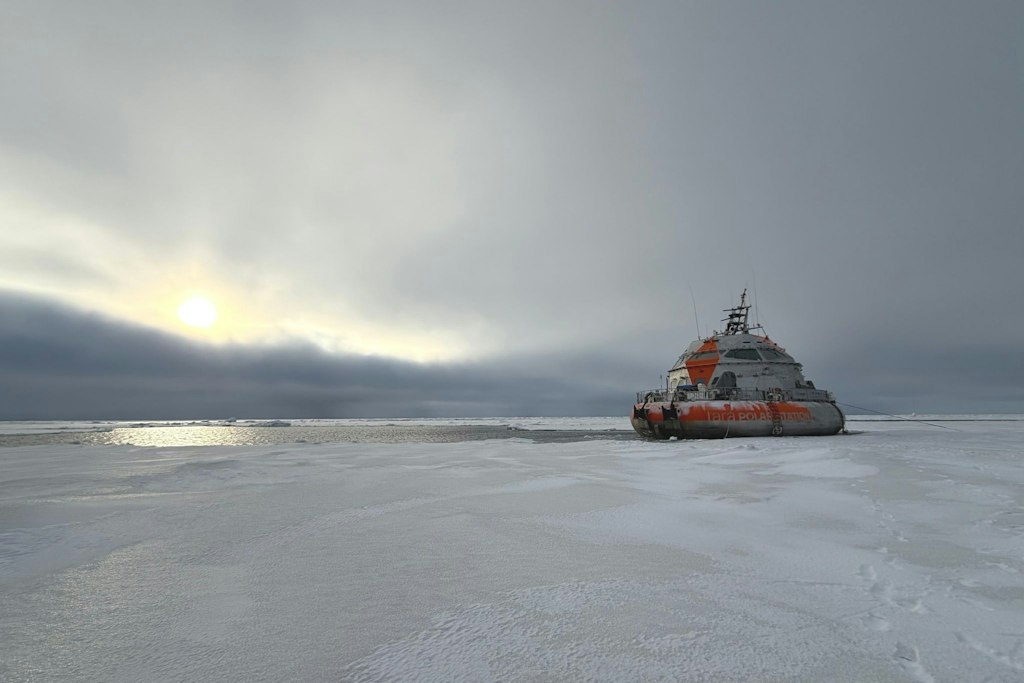
A ship that does not flee the ice — it seeks it out
In late August, an icebreaker left the port of Tromsø, in the far north of Norway, carrying a mission that sounds contradictory: instead of escaping the sea ice, the ship goes after it. And it will let itself be trapped.
On board are twelve people — six scientists and six crew members. The forecast is at least eight months of isolation for this initial group, while the vessel crosses the Arctic Ocean adrift, pushed by currents and by the movement of the ice pack itself.
The operation is coordinated by the Alfred Wegener Institute (AWI), the Helmholtz Centre for Polar and Marine Research, based in Bremerhaven, in northern Germany. It is one of the largest scientific efforts ever assembled in the region, budgeted at around 140 million euros.
How to trap a ship in the ice
The idea is simple in appearance and complex in execution. The icebreaker advances until it finds an ice floe thick and stable enough to serve as a platform. There, it slows down and waits for the ice itself to envelop it and turn it into a steel island.
From then on, the ship becomes a laboratory and a camp:
- Instruments are installed directly on the ice, in areas isolated from the hull;
- Towers measure wind, temperature, humidity and radiation throughout the entire annual cycle;
- Sensors descend into the water to track currents, salinity and the ocean's microscopic life;
- Other icebreakers periodically break a path to bring supplies, fuel and replacement teams.
The rotation of personnel is essential: in total, some 600 specialists from twenty countries are expected to pass through the project over the course of the year, in shifts. The group that boarded now is only the first.
On board, with a guard dog
Life on the ice is harsh. Researchers work in temperatures that can plunge below minus 40 degrees, face the polar night — months without the sun rising — and live with the permanent risk of unwanted encounters.
Polar bears are the main safety concern. That is why a dog travels with the team: it serves as a sentinel, able to notice the animals' approach before the humans do. The animal's presence is one of the protective measures adopted so that no one has to work unarmed and alone.
A century after Nansen
The strategy is not new. In the late 19th century, Norwegian explorer Fridtjof Nansen let his ship, the Fram, freeze on purpose in the Arctic ice, between 1893 and 1896, in the hope that the current would carry it to the North Pole. He did not reach it, but he returned with data that helped found modern oceanography.
Decades later, the Soviet Union set up scientific stations on drifting ice floes, some of them occupied for years on end. The new expedition revives that lineage, but with a crucial difference: today there are satellites, automatic sensors and computing power to turn every measurement into climate models.
Why the data matter
The Arctic is warming about twice as fast as the global average. The sea ice covering the region shrinks year after year, and this loss affects the climate of places very far away — including Brazil, by altering patterns of atmospheric and oceanic circulation.
The problem is that almost all available measurements cover only the summer, when access is easier. No one has ever followed, from start to finish, a complete cycle of freezing and thawing in the heart of the Arctic.
It is exactly this gap that the expedition intends to close. With a full year of simultaneous observations of the atmosphere, the ocean, the ice and the living beings that depend on it, scientists hope to calibrate models that still err today when predicting the region's future.
If all goes as planned, the ship will remain invisible for months, far from any port, slowly turning with the ice. When the thaw sets it free, the vessel will have traveled a path no laboratory could simulate — and brought in its hull the numbers that were missing to understand what is happening at the top of the world.