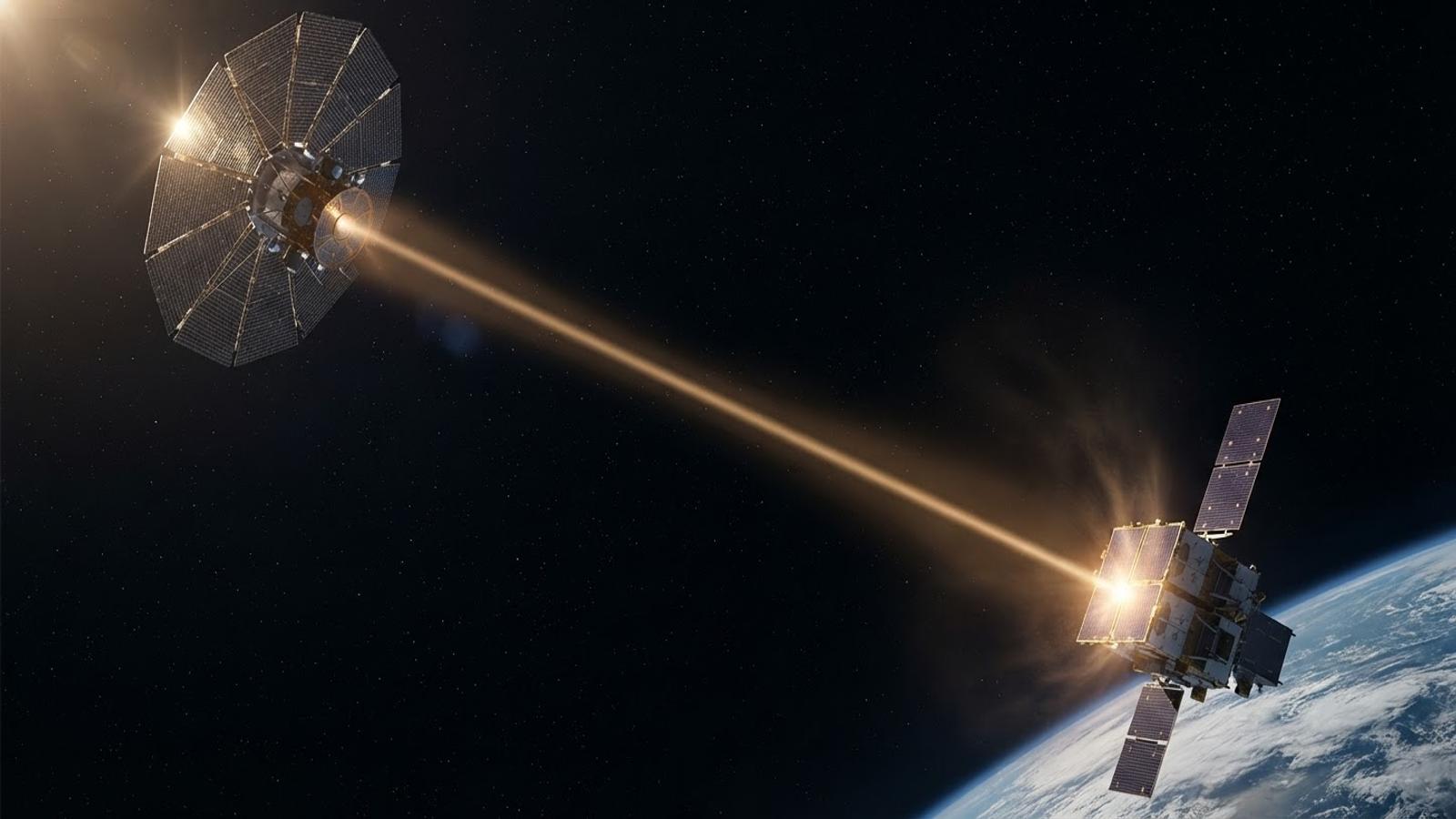
Protostar: the satellite that will connect space with wireless energy
Star Catcher Industries, an American startup, is preparing the first real test of wireless energy transfer between two satellites in orbit. The experiment will be carried out with Protostar, which is scheduled to launch in October 2026 aboard a SpaceX Falcon 9 from Vandenberg Space Force Base on the Transporter-18 mission.
After separation, Protostar will release a small cubesat equipped with conventional solar panels. The main satellite will then locate the cubesat, track its trajectory and send an optical energy beam directly to the target’s solar cells. Engineers will measure the amount of energy received and the efficiency of the process.
Technologies already validated in previous stages
The company has already tested parts of the system in isolation. Optical energy transmission was demonstrated on the ground at NASA’s Kennedy Space Center. In 2025, during the Sextant Alpha mission, the satellite detection and tracking software was validated in orbit.
Protostar’s flight will bring all these capabilities together in a single operational system. The goal is to prove that measurable amounts of energy can be delivered between two spacecraft without any physical connection.
An energy network in orbit
If the test is successful, Star Catcher plans to create an energy supply infrastructure in space. Earth observation satellites, military equipment and high-consumption orbital data centers will be able to receive extra power without relying solely on their own solar panels.
The company has already signed ten preliminary supply contracts with companies such as Starcloud, Loft Orbital, Astro Digital and Aethero. In addition, it has received more than 40 letters of intent from other potential clients. To date, it has raised US$ 88 million in venture capital and a US$ 60 million contract from the United States Space Force (STRATFI).
Next steps
In parallel, Star Catcher is developing a larger second-generation satellite designed to provide commercial energy rather than merely demonstrate the technology. The outcome of Protostar’s flight will be decisive in showing whether the idea of an orbital energy network is viable.